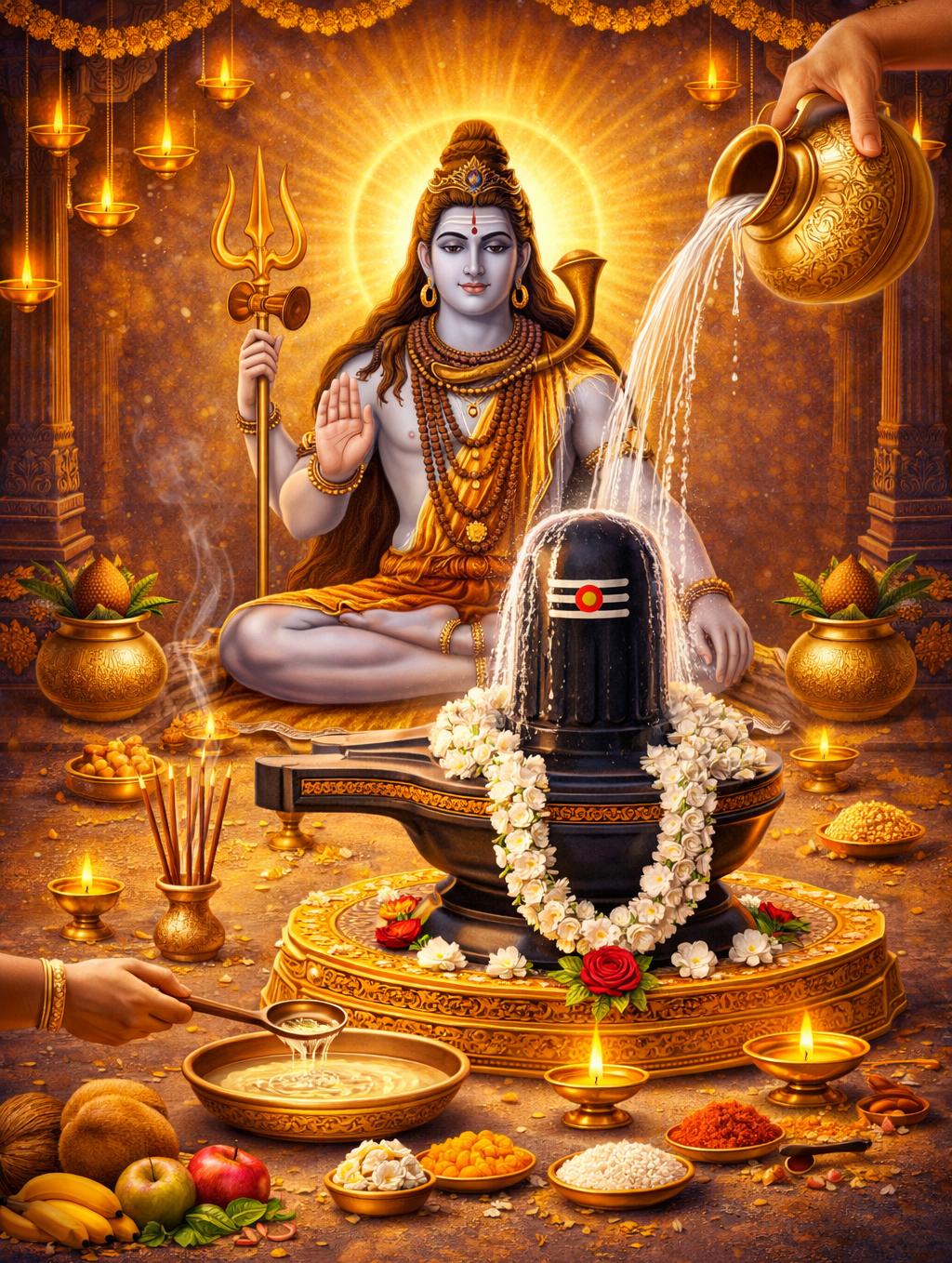
Among all Shaiva rituals, Rudrabhishekam occupies a place of supreme reverence. It is the elaborate ceremonial bathing of the Shiva Linga — the formless form of Lord Shiva — with a succession of sacred substances, each carrying a distinct vibrational quality and a specific boon it invokes. When performed by a trained Tantri reciting the Sri Rudram and Chamakam with perfect intonation, Rudrabhishekam is considered one of the most potent rituals in the entire Vedic canon.
The word "abhishekam" comes from the Sanskrit root abhi (towards) and seka (pouring). It is the act of consecrating a deity by pouring sacred liquids, accompanied by Vedic chanting. "Rudra" refers to Lord Shiva in his fierce, storm-god aspect — the destroyer of ego, disease, and death. Together, Rudrabhishekam means "the pouring of consecrated substances on the Rudra form of Shiva."
The Source: Sri Rudram and Chamakam
The scriptural foundation of Rudrabhishekam is the Sri Rudram — a hymn from the Krishna Yajurveda, specifically from the Taittiriya Samhita (4.5.1–11). It consists of two sections: the Namakam (11 anuvakas invoking Rudra) and the Chamakam (11 anuvakas requesting boons). Together they form a complete prayer cycle — first acknowledging Shiva's cosmic powers, then listing the blessings sought in return.
"The Sri Rudram is not merely a hymn. It is a map of the entire cosmos, with Rudra as both the territory and the guide. Each of the 11 anuvakas vibrates at a specific frequency that corresponds to a different aspect of creation."
Reciting the entire Sri Rudram and Chamakam once is called one avartanam. Eleven avartanams performed together constitute an Ekadasha Rudrabhishekam — an extremely powerful variant performed for major karmic clearing and healing.
The Sacred Substances: What Each Abhisheka Means
A full Rudrabhishekam employs multiple substances poured in succession over the Shiva Linga. Each material carries its own energetic resonance:
Milk (Ksheera)
Purification of the mind, peace, longevity, and maternal blessings
Honey (Madhu)
Sweet speech, harmonious relationships, and attraction of abundance
Coconut Water
Clearing negativity, spiritual progress, and mental clarity
Curd (Dadhi)
Prosperity, fertility, and family wellbeing
Ghee (Sarpi)
Intelligence, tejas (inner radiance), and liberation
Sugar (Sharkara)
Removal of ego, sweetness in life, and success in endeavours
Rose Water
Devotion, divine love, and purification of emotions
Panchamrita
The five-nectar mix (milk+curd+ghee+honey+sugar) — bestows all blessings
Why the Shiva Linga?
The Shiva Linga is often misunderstood by those unfamiliar with Vedic symbolism. It is not a physical object of worship in the ordinary sense — it is a representation of the infinite, formless consciousness (Brahman) that underlies all of creation. The word "linga" in Sanskrit means "mark" or "symbol" — it is the mark of Shiva's omnipresence.
The oval or cylindrical form represents the unmanifest, beginningless, endless nature of pure awareness. The base (yoni pitha) represents Shakti — the primordial energy without which even consciousness cannot express itself. Their union in the Shiva Linga form depicts the non-dual reality at the heart of Vedanta.
Benefits of Rudrabhishekam
The Vedic texts are explicit about the results of a sincere Rudrabhishekam. Across the Puranas and Agamas, the following benefits are described:
- Relief from chronic illness and accelerated recovery from health conditions
- Removal of Kala Sarpa Dosha, Mangal Dosha, and Pitru Dosha
- Protection from negative energies, evil eye, and black magic
- Resolution of marital discord and fertility-related challenges
- Career breakthroughs and removal of financial blockages
- Mental peace, clarity, and release from anxiety and fear
- Blessings of children for those who desire progeny
- Accelerated spiritual progress and proximity to liberation
Who Should Have Rudrabhishekam Performed?
Rudrabhishekam is recommended for virtually any auspicious occasion or pressing life challenge. It is especially appropriate for:
- Birthdays — especially Janma Nakshatra (birth star) days
- Pradosham (the 13th lunar day, Trayodashi) — the most auspicious time for Shiva worship
- Shivaratri (monthly and the annual Maha Shivaratri)
- Those in difficult Saturn, Rahu, or Ketu dasha periods
- Anyone experiencing persistent health, career, or relationship obstacles
- Before significant life events — surgery, new business launch, wedding
"Shiva is called Ashutosh — the easily pleased one. He does not demand elaborate preparation. What he requires is a pure heart and sincere intention. The ritual is the vehicle; your devotion is the fuel."
Rudrabhishekam for NRIs
Dr. Aswanidev Tanthri performs Rudrabhishekam at authenticated Shiva temples in Kerala, with your name and nakshatra chanted throughout the sankalpa. You receive:
- Full video of the ritual (typically 90–120 minutes for Ekadasha Rudram)
- Prasadam of vibhuti (sacred ash from the abhisheka), kumkum, and bilva leaves
- Option to join live via WhatsApp video at the peak moment of the ritual
- Post-pooja consultation if desired