Entering a new home is one of the most significant transitions in a family's life. In the Vedic tradition, this moment is not left to chance — it is carefully consecrated through the Griha Pravesa ceremony, a ritual that purifies the space, invites divine presence into every corner, and establishes a protective energetic signature for the family who will live there.
For NRI families in the UK, USA, UAE, and Australia who build or purchase homes in India — or who want to consecrate a new home wherever they live — this guide provides everything you need to prepare confidently for your Griha Pravesa.
What Is Griha Pravesa?
"Griha" means home; "Pravesa" means entry. Together, Griha Pravesa is the sacred first entry into a new dwelling. It is described in the Grihya Sutras — the ancient texts governing household rituals — as one of the 16 principal life samskaras (rites of passage). The ceremony establishes the home as a sacred space, a kshetra, where the family can pursue the four purusharthas — dharma, artha, kama, and moksha — with divine support.
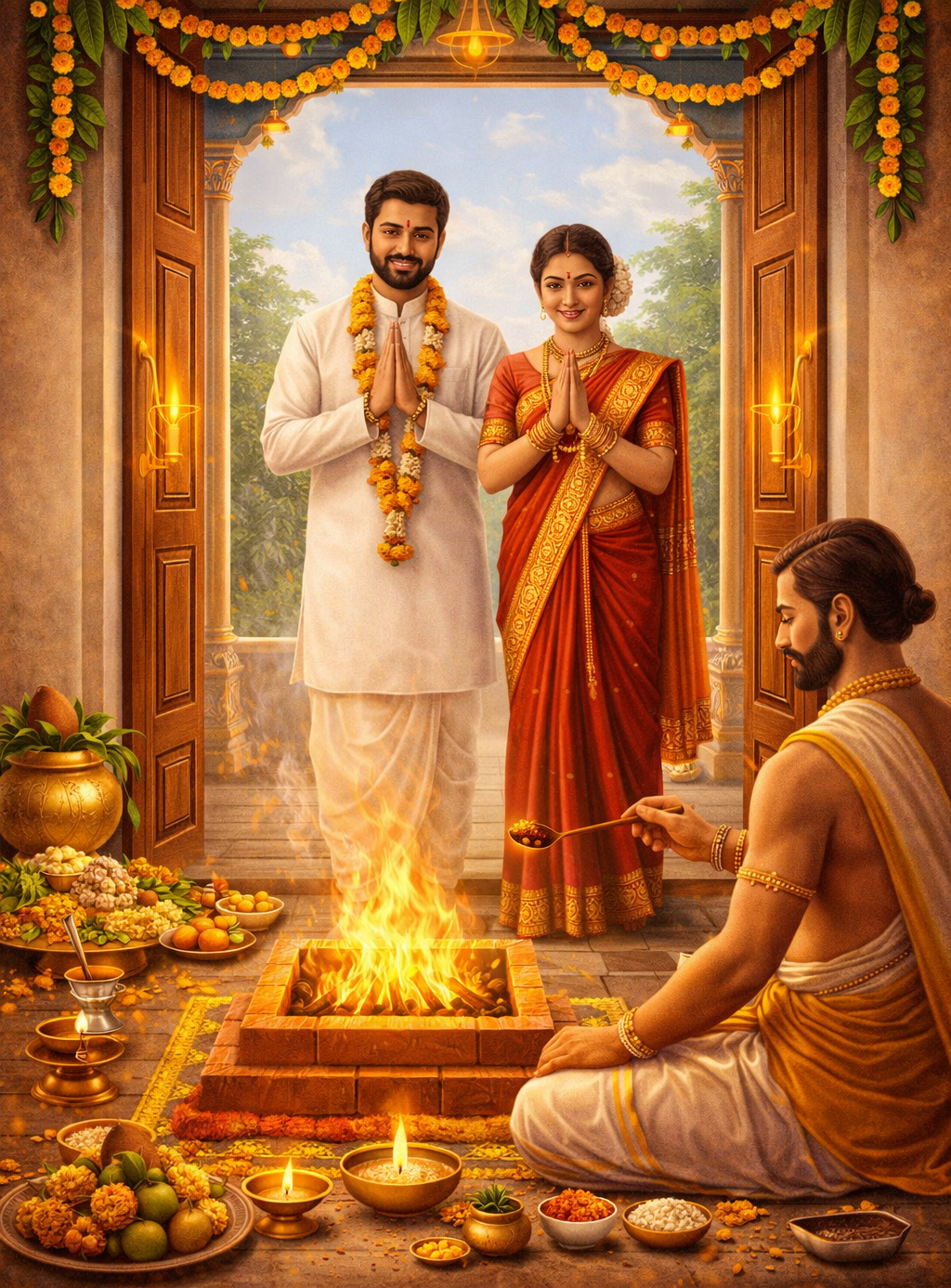
Step 1: Choosing the Right Muhurtham
The most important preparation is selecting an auspicious muhurtham — a precise window of time when planetary positions favour new beginnings. Not all dates are suitable. A Vedic astrologer will examine:
- The Tithi (lunar day) — Saptami, Dwadashi, and Trayodashi are traditionally favoured
- The Nakshatra of the day — Rohini, Hasta, Mrigashira, Anuradha are considered auspicious
- The Vara (weekday) — Monday, Wednesday, Thursday, and Friday are preferred
- The Lagna (ascendant) at the time of entry — must be a fixed sign for stability
- The homeowner's personal chart — to avoid conflicts with their natal dashas
Dr. Aswanidev Tanthri provides muhurtham consultation as part of the Griha Pravesa booking. Share your preferred date range and he will identify the most auspicious window within it.
Step 2: The Vastu Shanti Component
For newly constructed homes, the Griha Pravesa typically includes a Vastu Shanti — a ritual to harmonise the five elements (Pancha Bhutas) within the structure. This involves:
- Establishing a Vastu Purusha mandala in the north-east corner (Ishanya)
- Performing a Bhoomi Puja to honour the earth the structure rests upon
- Purifying each direction (disha) with specific mantras and offerings
- Installing a copper kalasha (pot) at the foundation or doorstep
"The house itself is a body — it has a spine (the central axis), a head (the north-east), limbs (the cardinal directions), and a soul (the sacred fire at its centre). Griha Pravesa awakens that soul."
Step 3: Items to Keep Ready
Griha Pravesa Preparation Checklist
- Fresh mango leaf torana (garland) for the main entrance
- Kolam/rangoli powder for threshold decoration
- One new brass or copper kalasha with coconut on top
- Ghee lamp (diya) with cotton wicks
- Camphor (karpoora) and incense sticks
- Fresh flowers — marigold, jasmine, lotus if available
- Turmeric, kumkum, vibhuti (sacred ash)
- Coconuts (minimum 5), bananas, and seasonal fruits
- Raw rice, sesame seeds, and jaggery
- New set of clothes for all family members
- A pot of freshly cooked rice (for the Aadupaniyam offering)
- Milk for the threshold boiling ceremony (Paal Kaychi)
Step 4: The Milk-Boiling Ceremony
One of the most beloved elements of Griha Pravesa is the Paal Kaychi or milk-boiling ritual. A new vessel of milk is placed on the stove and allowed to boil over — the overflow symbolising abundance, prosperity, and the overflowing blessings of Lakshmi into the home. The family watches together as the milk boils, and the direction it overflows is traditionally read as an omen.
Step 5: The Pooja Ceremony Itself
The main ceremony, performed by Dr. Aswanidev Tanthri (either in person or via live video), typically follows this sequence:
- Ganapathi Pooja — invoking Ganesha to remove obstacles
- Punyahavachanam — purification of the space with holy water and mantras
- Navagraha Pooja — propitiating the nine planets for the dwelling
- Vastu Shanti (if applicable)
- Griha Devata invocation — establishing the protective household deity
- Homam (fire ritual) for blessings and purification
- Kalasha Puja and Abhishekam
- Family's ceremonial first entry — right foot first, holding a lamp
Can the Pooja Be Performed Virtually?
Yes — and many NRI families choose this option. If you are abroad and your home is in India (or vice versa), here is how it works:
- A family member or trusted person represents you at the home in India
- You join the ceremony live via WhatsApp video call
- Dr. Aswanidev Tanthri performs the full sankalpa in your name and nakshatra
- All prasadam is collected and can be couriered to you
- You perform the milk-boiling and lamp rituals simultaneously at your overseas home
"Distance does not diminish the power of the sankalpa. When your name and nakshatra are invoked in the sacred fire, the blessing flows to you wherever you are."
Book Your Griha Pravesa
To book, simply message us on WhatsApp with your preferred dates, the location of the home (state in India or country abroad), and your birth details for muhurtham calculation. Dr. Aswanidev Tanthri personally confirms every booking.