Of all the thousands of mantras preserved in the Vedic tradition, few carry the concentrated power of the Mahamrityunjaya Mantra — the great mantra that conquers death. Found in the Rig Veda (7.59.12) and the Krishna Yajurveda, this mantra addresses Tryambaka — Shiva in his three-eyed form — and invokes the most fundamental human longing: release from suffering, fear, and the cycle of death and rebirth.
Yet to reduce the Mahamrityunjaya to a "health mantra" is to see only its outermost layer. This article peels back each layer of meaning to reveal why saints, scholars, and sincere devotees across millennia have considered this mantra one of the supreme gifts of the Vedic revelation.
The Mantra Itself
उर्वारुकमिव बन्धनान्मृत्योर्मुक्षीय माऽमृतात्
Urvaarukamiva Bandhanaan Mrityormuksheeya Maamritaat
Word-by-Word: The Hidden Architecture
Sanskrit mantras carry meaning at multiple levels simultaneously. Each word of the Mahamrityunjaya is a doorway:
ॐ (Om)
The primordial sound — the first vibration of creation. Om is not a word; it is the sonic form of Brahman, the undivided consciousness that precedes and pervades all things. Beginning the mantra with Om aligns the entire recitation with the frequency of absolute reality.
त्र्यम्बकं (Tryambakam) — The Three-Eyed One
Tryambaka refers to Lord Shiva's three eyes. The first two eyes perceive the physical world — past and future, cause and effect. The third eye, located between the brows at the Ajna chakra, perceives the eternal present, the non-dual truth beneath all appearances. To worship Tryambaka is to seek the vision that transcends ordinary sight.
सुगन्धिं (Sugandhim) — The Fragrant One
This epithet describes Shiva as fragrant — not in a physical sense, but as the divine quality that radiates from a purified soul. Just as a flower's fragrance cannot be seen but permeates the entire space around it, Shiva's grace permeates all of existence invisibly yet unmistakably.
पुष्टिवर्धनम् (Pushtivardhnam) — Nourisher of All
"Pushti" means nourishment, vitality, and flourishing. "Vardhnam" means one who increases. This word reveals Shiva not as a destroyer alone (a common misconception) but as the cosmic nourisher — the one who increases the life force of all beings who turn toward him in devotion.
"Shiva destroys only what is false. What is real — your soul, your love, your awareness — he protects and nourishes without limit."
उर्वारुकमिव (Urvaarukamiva) — Like a Cucumber from Its Vine
This is the most poetic and philosophically rich image in the mantra. The urvaaruka is a type of cucumber. When ripe, it detaches naturally from the vine — not by force, but by perfect maturity. The mantra asks that we be released from death (mrityor) and from bondage (bandhanaat) in the same way: not by struggling against life's entanglements, but by ripening into readiness for release.
मृत्योर्मुक्षीय माऽमृतात् (Mrityormuksheeya Maamritaat)
The climax: "May I be liberated from death, not from immortality." This is the essential prayer — not for mere physical survival, but for freedom from the fear of death and ultimately from the cycle of rebirth itself (samsara). The "immortality" (amrita) referred to is not endless physical life — it is moksha, the permanent dissolution of the ego-self into divine awareness.
The Three Levels of Meaning
Adhibhautika — The Physical Level
At the most immediate level, the Mahamrityunjaya mantra is a prayer for health, healing, and long life. Clinical observations across generations of practitioners suggest that sincere chanting activates the parasympathetic nervous system, reduces stress hormones, and promotes healing. Modern research on the physiological effects of mantra chanting — particularly at the specific frequencies of Vedic Sanskrit — supports these observations.
Adhidaivika — The Cosmic Level
At the intermediate level, the mantra is a ritual communication with Tryambaka — a specific aspect of Shiva's cosmic intelligence. The mantra creates a vibrational bridge between the devotee's individual consciousness and the infinite consciousness of Shiva. Through this bridge, planetary afflictions (particularly those of Saturn, Mars, and Ketu — planets associated with death, injury, and disease) are softened and resolved.
Adhyatmika — The Spiritual Level
At the deepest level, the Mahamrityunjaya mantra is a meditation on non-duality. It contemplates what it would mean to be truly free — not from physical death (which is inevitable) but from the mistaken identification with the body and ego that makes death terrifying. The ripened cucumber does not fear separation from the vine; it has fulfilled its purpose. The mantra aspires to that state of fulfilled, fearless completion.
How to Practice the Mahamrityunjaya Mantra
- Recite on a rudraksha mala (108 beads) — rudraksha is specifically connected to Shiva and amplifies the mantra's resonance
- The ideal time is Brahma muhurtham (approximately 4–6 AM) or at sunset (Pradosh Kalam)
- Face east or north during recitation
- Light a ghee lamp and offer bilva leaves to a Shiva Linga or image
- Recite with correct pronunciation — svara (intonation) matters; listen to recordings by trained Vedic pandits before beginning personal practice
- For illness or acute crisis, 108 repetitions daily for 40 days (a mandala) is the traditional prescription
The Mrityunjaya Homam: The Ritual Form
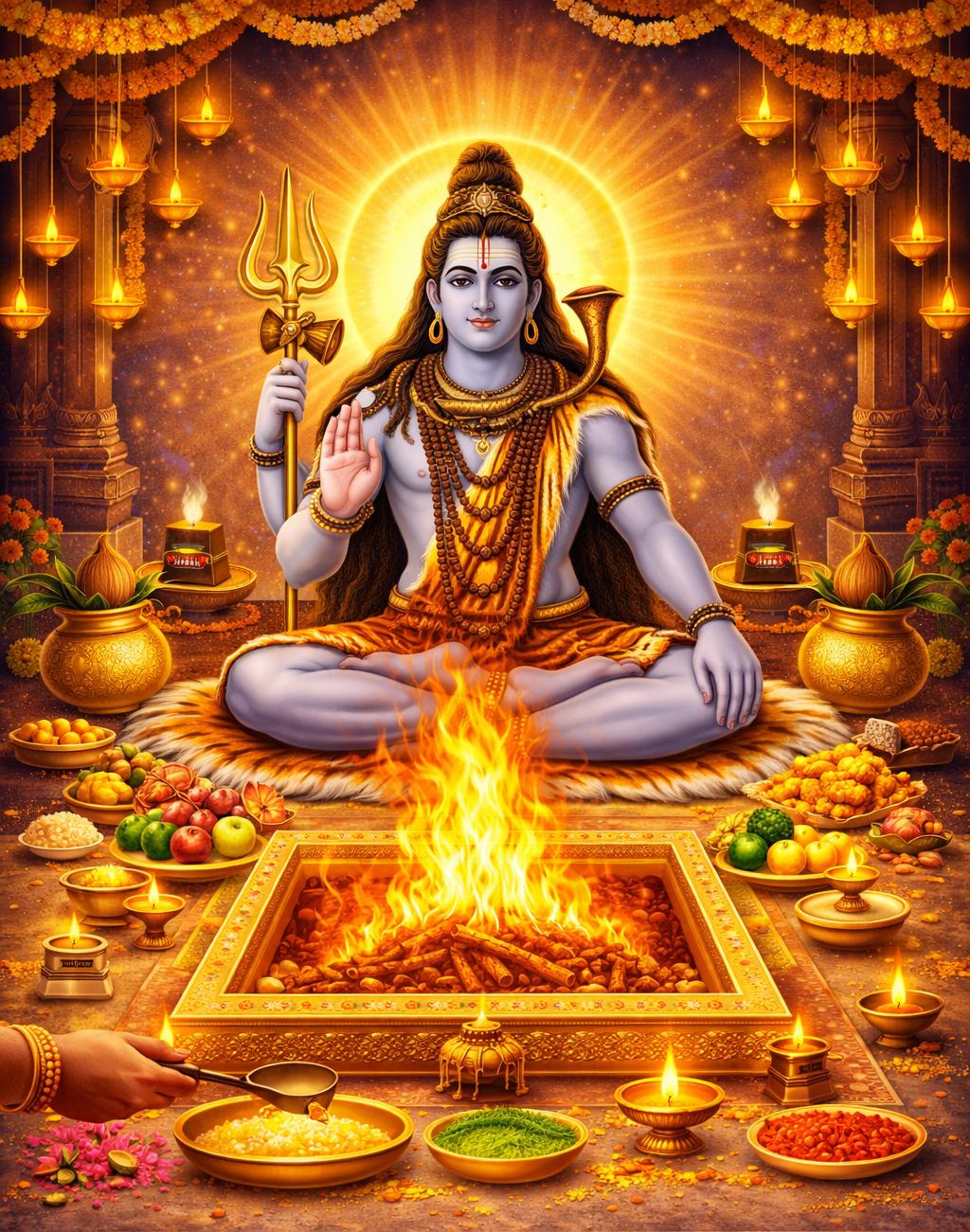
While personal mantra practice is valuable, the Mrityunjaya Homam — the fire ritual form of this mantra — multiplies its power exponentially. When a trained Tantri performs the homam with correct agni (fire), the 1,008 or 10,008 ahutis (fire offerings), each accompanied by the mantra, the cumulative vibrational effect is considered capable of reversing serious illness, protecting against fatal accidents, and creating an energetic shield around the devotee's family.
Dr. Aswanidev Tanthri performs Mrityunjaya Homam with Laghu (small, 1,008 ahutis) and Maha (large, 10,008 ahutis) variants. Both are available for NRI devotees worldwide.