Among the various karmic afflictions described in Vedic astrology and the Puranas, Pitru Dosha is among the most commonly encountered — and the most frequently misunderstood. It is not a curse, a punishment, or a permanent condition. It is an energetic imbalance arising from unsettled debts to one's ancestors (pitrus), and like all karmic imbalances, it can be addressed, resolved, and transformed through the appropriate Vedic rituals.
For many NRI families — particularly those who have migrated abroad and lost continuity with ancestral rites — Pitru Dosha is more prevalent than they may realise. This article provides the complete picture: what it is, how to recognise it, what causes it astrologically, and precisely which rituals remedy it.
Who Are the Pitrus?
In the Vedic worldview, the universe is held together by three primary debts (Trini Rinani) that every human being is born with:
- Deva Rina — debt to the gods, repaid through worship and yajna
- Rishi Rina — debt to the sages, repaid through study of the scriptures and passing knowledge forward
- Pitru Rina — debt to the ancestors, repaid through performing their prescribed rites (shraddha) and continuing the family lineage
The Pitrus are the souls of deceased ancestors who exist in an intermediate realm (Pitru Loka) between physical death and their next incarnation. They are not omniscient, but they retain awareness of their living descendants and are capable of influencing the family's wellbeing — positively when properly honoured, and through karmic friction when neglected.
"The Pitrus are not demanding propitiation out of ego. They are signalling unfinished business — karmic threads between their souls and ours that need to be consciously completed before they and we can move forward."
What Causes Pitru Dosha?
Pitru Dosha can arise from two sources: karmic actions of ancestors and neglect of ancestral rites by the living.
1. Ancestral Karmic Debts
If an ancestor committed significant misdeeds in their lifetime — harm to others, breach of dharmic duty, exploitation of the vulnerable — these unresolved karmas can manifest as Pitru Dosha in subsequent generations. This is not collective punishment; it is karmic resonance passing through the family field until someone in the lineage consciously addresses it.
2. Neglect of Shraddha and Tarpan
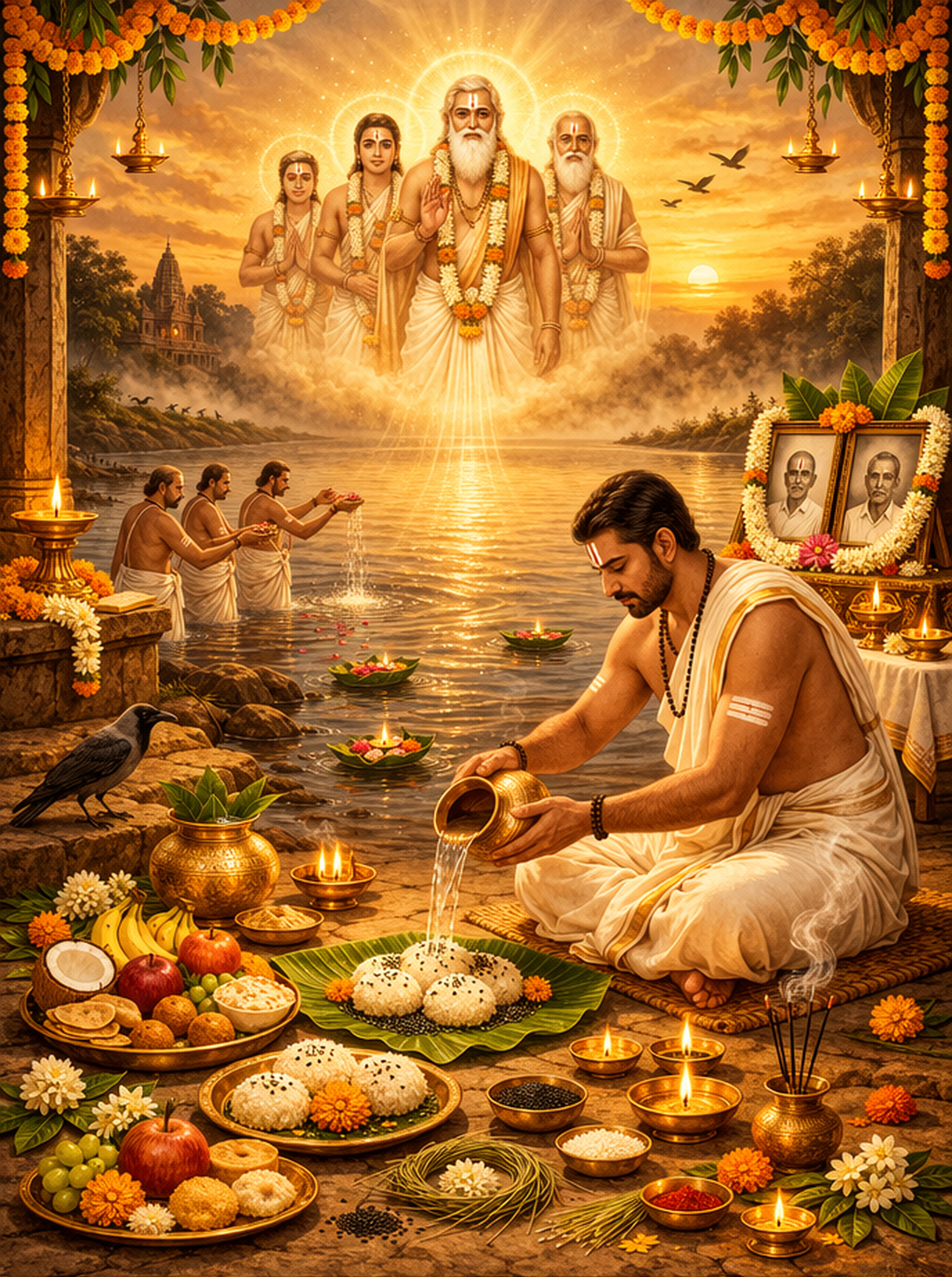
Shraddha (the annual ancestor ritual performed during Pitru Paksha) and Tarpan (daily water offering to ancestors) are prescribed in the Dharma Shastras as non-negotiable duties. When these rites are abandoned for multiple generations — as often happens in diaspora families — the ancestral connection weakens and Pitru Dosha builds up in the family field.
3. Improper Death Rites
If a family member died away from home, without proper Antyesti (last rites), or in unusual circumstances, their soul may remain in an unsettled state. This unsettled energy is one of the most potent triggers of Pitru Dosha in the family.
Astrological Indicators of Pitru Dosha
A trained Vedic astrologer identifies Pitru Dosha through specific planetary combinations in the natal chart:
- Sun (karaka of father/ancestors) afflicted by Rahu, Ketu, or Saturn in the 9th house
- Rahu or Ketu in conjunction with the Sun in any house
- The 9th house lord (dharma and ancestors) placed with malefics
- Saturn and Rahu in the same house — especially the 1st, 5th, or 9th
- Moon (mind/mother lineage) severely afflicted — indicating matrilineal ancestral issues
- The 5th house (progeny) afflicted — indicating Pitru Dosha expressing through fertility challenges
Signs of Pitru Dosha in Daily Life
Common Manifestations of Pitru Dosha
- Repeated miscarriages or unexplained fertility challenges
- Persistent obstacles in marriage — delays, repeated breakups, unsuitable matches
- Children born with unexplained health challenges
- Financial instability despite genuine effort and competence
- Recurring dreams featuring deceased ancestors, especially distressing ones
- Sudden accidents or untimely deaths recurring across generations
- Mental health challenges — particularly depression and anxiety — without clear cause
- Family disputes that seem to arise from nowhere and cannot be resolved
- A persistent sense of being blocked, as if an invisible wall prevents progress
It is important to note that these symptoms alone do not confirm Pitru Dosha — they may have other causes. Confirmation requires a proper Jathakam analysis by a trained astrologer who can identify the specific planetary pattern.
The Vedic Remedies for Pitru Dosha
1. Pitru Paksha Shraddha
Pitru Paksha is the 16-day period in the Hindu calendar (typically September–October) specifically designated for ancestral rites. Performing Shraddha — the formal ritual feeding of Brahmins on behalf of ancestors — during this period is the most potent annual remedy for Pitru Dosha. Dr. Aswanidev Tanthri performs these rites on behalf of NRI families worldwide during Pitru Paksha each year.
2. Narayan Bali and Nag Bali
For severe Pitru Dosha — especially when an ancestor died in unusual circumstances (accident, suicide, childlessness) — the Narayan Bali ritual is prescribed. This is a three-day ceremony performed at specific sacred sites (particularly Trimbakeshwar in Nashik or Gaya in Bihar) that formally releases the unsettled soul and clears the ancestral field. It is considered the most complete remedy for deep Pitru Dosha.
3. Tripindi Shraddha
When three consecutive generations of Shraddha have been neglected, Tripindi Shraddha is performed to compensate for the accumulated backlog. This ritual specifically addresses the three generations of pitrus and is performed at auspicious tirthas.
4. Pinda Dana at Gaya
The Vishnu Gaya Kshetra in Bihar is considered the most sacred site for ancestral rites in the entire Vedic tradition. The Garuda Purana states that Pinda Dana offered at Gaya liberates seven generations of ancestors simultaneously. For NRIs who cannot travel to Gaya, Dr. Aswanidev Tanthri can arrange for these rites to be performed there on your behalf.
5. Daily Tarpan Practice
For those with mild Pitru Dosha or as a regular maintenance practice, daily Tarpan — offering water mixed with black sesame seeds to the ancestors while facing south — is an effective and simple remedy. It requires no priest and can be performed by anyone after proper instruction.
6. Pitru Dosha Shanti Pooja
A dedicated Pitru Dosha Shanti Pooja includes Navagraha Pooja (with specific emphasis on Sun and Saturn), Pitru Tarpan, and a homam with sesame and other ancestral offerings. This is available through Tapovanam Poojas and is suitable for those who cannot travel to sacred sites.
"Performing ancestral rites is not superstition — it is the most pragmatic of spiritual acts. You are settling a karmic account that, if left open, continues to draw interest across generations."
NRIs and Pitru Dosha: A Special Concern
The Indian diaspora in the UK, USA, UAE, Australia, and Singapore faces a unique challenge. The ancestral rituals that were maintained naturally in joint family systems in India — the annual Shraddha, the monthly Amavasya Tarpan, the death anniversary rites — are easily disrupted when families migrate. Often, two or three generations pass without these rites being performed.
This does not mean the Pitru Rina automatically converts into severe Pitru Dosha — the ancestors understand the circumstances of migration. But the conscious intention to re-establish the connection, expressed through even a single sincere Pitru Paksha Shraddha, is powerful enough to initiate healing of the ancestral field.